
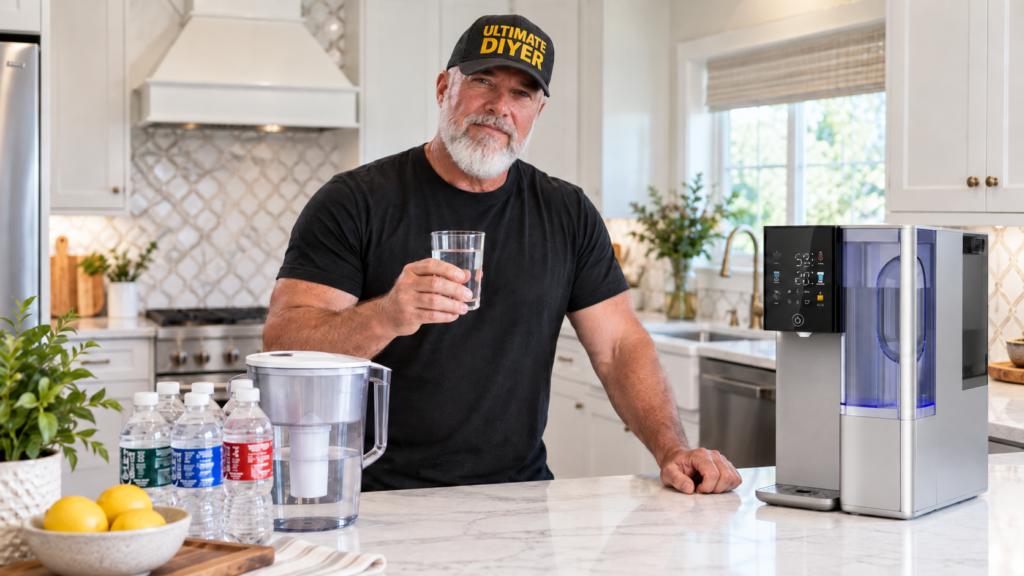
How do you get better drinking water when you live in an apartment, rent your home, own an RV, or simply do not want to drill a countertop or modify plumbing?
The best answer depends on the problem you are actually trying to solve. For some people, ordinary municipal tap water is already the simplest and least expensive choice. Others may only want better taste or odor. Some want more aggressive treatment such as distillation or reverse osmosis. And for renters who want RO water without a drain saddle, dedicated faucet, or permanent supply connection, countertop RO has become an especially interesting option.
This guide compares the major choices using Dallas as a real-world example. The goal is not to convince everyone to buy a filter. It is to understand the source water, understand what can happen inside a building, and then choose the level of treatment that fits your situation.
Watch the Full Video
Quick Answer
If your municipal water tastes fine and you are comfortable with your local water-quality report, the tap may still be all you need. If taste or odor is the main complaint, a pitcher filter may be enough. Distillation and reverse osmosis provide much more aggressive treatment. Countertop RO is especially useful when you want RO water but do not want to alter a rental property or make permanent plumbing changes.
1. Start With the Water You Already Have
Before buying any filter, start with a basic question: what is actually coming into the building? A public water-quality report can tell you a great deal about the water leaving the municipal system, which helps keep the discussion grounded in data instead of fear.
Dallas is a useful example. Dallas Water Utilities reports that the system meets or exceeds applicable state and federal water-quality requirements. The 2025 report identifies seven surface-water sources: the Elm Fork of the Trinity River plus Lakes Ray Roberts, Lewisville, Grapevine, Ray Hubbard, Tawakoni and Fork.
The first lesson: a filter is not automatically necessary simply because tap water came through a municipal system. Start with your local water-quality report, then decide what problem – if any – you are trying to solve.
2. Good City Water Can Still Pick Up Problems Inside a Building
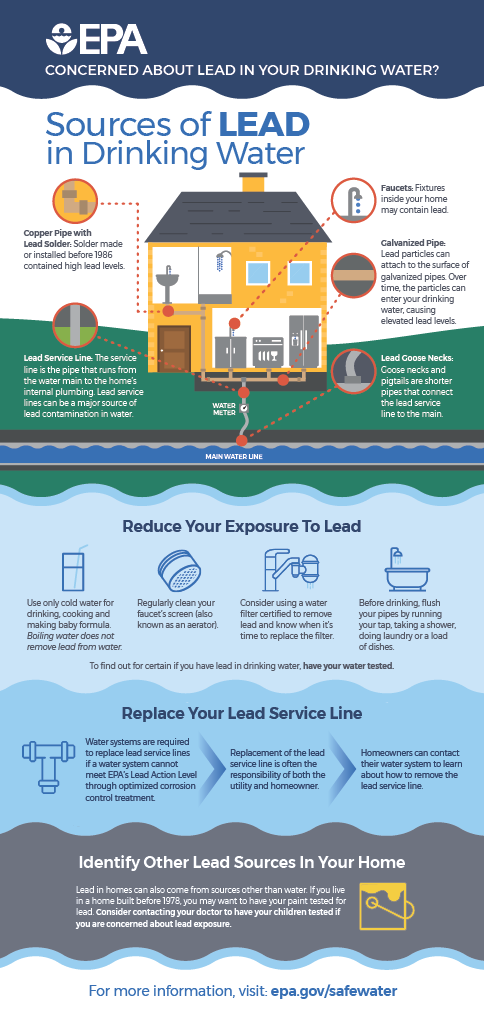
A city report tells you how the public system is performing, but it cannot guarantee the condition of every service line, pipe, fitting and fixture between that system and the glass in your hand.
Dallas notes that lead in drinking water is primarily associated with service lines and home plumbing. Older solder, galvanized piping, lead-containing components and aging fixtures can affect water after it has already passed the municipal treatment plant. That distinction is especially important in older homes, apartments and commercial buildings.
If water has been sitting for several hours, the Dallas report recommends flushing the tap before using the water for drinking or cooking as one way to reduce potential lead exposure.
Practical takeaway: municipal testing answers, “How is the public system doing?” A home or building water test answers a different question: “What is actually reaching this faucet after traveling through this property?”
3. What a Water-Quality Report Can – and Cannot – Tell You
The Dallas report is a good educational example because it presents detected constituents together with regulatory limits and system context. It also makes a point that applies to both tap and bottled water: the presence of a detected substance does not automatically mean the water poses a health risk. Concentration, exposure, regulatory limits and the specific substance all matter.
We are not selling fear. The useful question is not simply “Was something detected?” It is: what was detected, at what level, what standard applies, and what additional treatment – if any – do you personally want?
4. Bottled Water: Maximum Convenience, Ongoing Cost
Bottled water wins on convenience. There is no installation, no filter to maintain and no appliance taking up counter space. For occasional use, travel or emergency storage, that can be hard to beat.
The tradeoff is recurring cost. You also have to carry cases home, store them and dispose of the plastic. A case at a time can feel inexpensive while becoming one of the highest-cost options over a full year of daily use.
Bottled water can be convenient, but convenience is not the same thing as knowing every characteristic of the water inside the bottle. If you need detailed information about a specific bottled water, look for current labeling and appropriate laboratory or manufacturer documentation.
5. Bottled Water and Heat: Storage Conditions Matter
PET bottles are widely used for beverages and are intended for normal storage conditions, but research shows that prolonged high temperatures can increase migration from packaging into water.
Studies have reported increased antimony migration as storage temperature and time rise. A 2020 Acta Biomedica study reported that water held at 50 C reached 8.53 ppb antimony after 24 hours and 16.8 ppb after seven days under the study conditions. Other research has also examined heat, handling and the release of nano- and microplastics from PET bottles.
Practical takeaway: this does not mean bottled water sitting on a kitchen counter is automatically unsafe. It means prolonged storage in a hot vehicle, garage or direct sun is a different condition than normal room-temperature storage, and avoiding unnecessary heat exposure is reasonable.
6. Filter Pitchers: The Simplest Low-Cost Upgrade
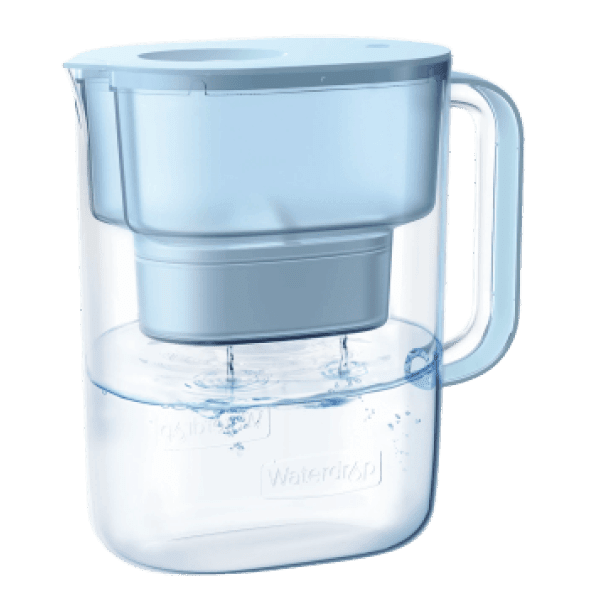
A filter pitcher is often the right answer when the complaint is taste, odor or general drinking-water preference rather than a need for aggressive treatment. It requires no plumbing, no electricity and very little counter space.
The important thing is to read the actual certification and reduction claims for the filter you buy. A pitcher filter should not be treated as interchangeable with reverse osmosis because different filter media are designed to reduce different things.
Example used in this project: Waterdrop PT-07B.
Affiliate note: Some product links in this guide are affiliate links. Ultimate DIYer may earn a commission at no additional cost to you.
7. Distillation: Another No-Plumbing Path
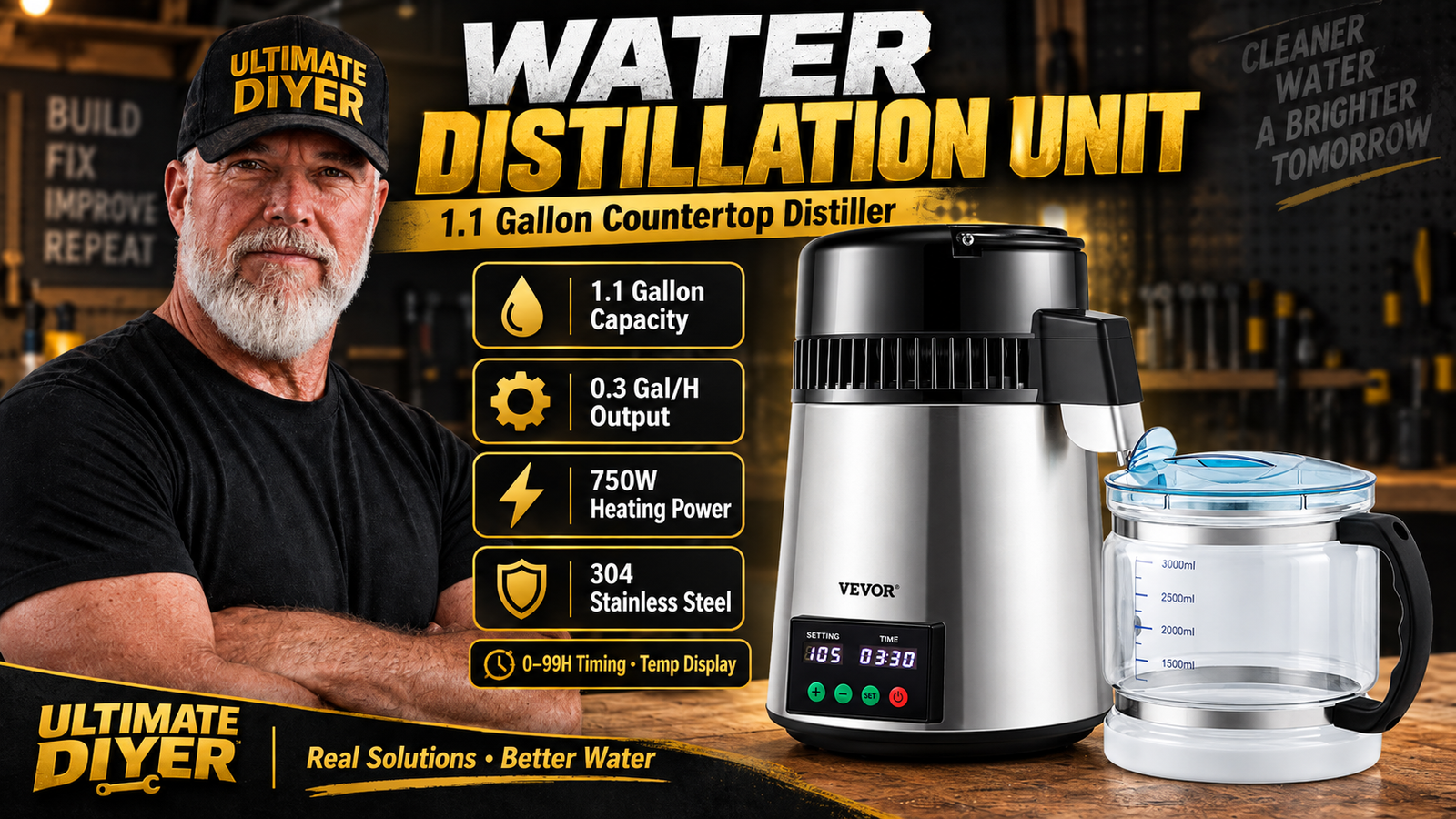
A countertop distiller also avoids plumbing completely. Instead of forcing water through a membrane, it boils water, captures the vapor and condenses that vapor back into liquid water. Much of what does not vaporize remains in the boiling chamber.
The tradeoff is time and energy. Distillation is slow compared with most RO systems, and the concentrated residue left in the boiling chamber has to be cleaned away. On the other hand, the process is easy to understand, requires no plumbing and can be useful for people who specifically want distilled water.
Example used in this project: VEVOR 1.1-gallon countertop distiller.
8. Under-Sink Reverse Osmosis: Excellent Filtration, Real Installation
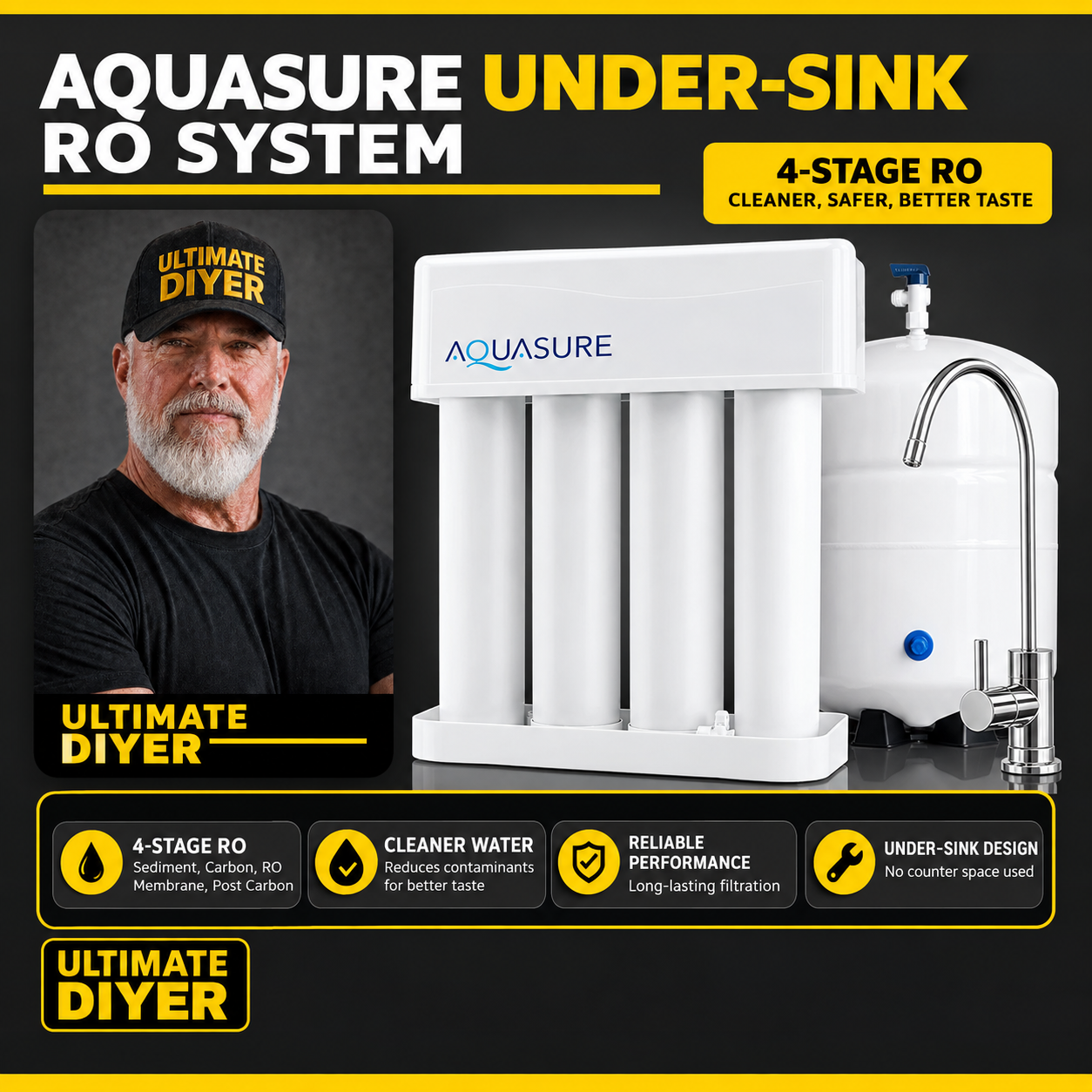
Traditional under-sink RO is a strong option when you own the home, have room under the sink and do not mind making plumbing connections. It is a permanent solution, but that permanence is exactly what makes it less attractive for many renters.
The Aquasure Premier 4-stage system is an example of a traditional multi-component under-sink RO. It requires the usual installation work: supply connection, drain connection, dedicated faucet and space for the filters and tank. We will cover that system in a separate installation and testing project.
Compact Under-Counter RO: Less Cabinet Space, Still a Plumbing Project
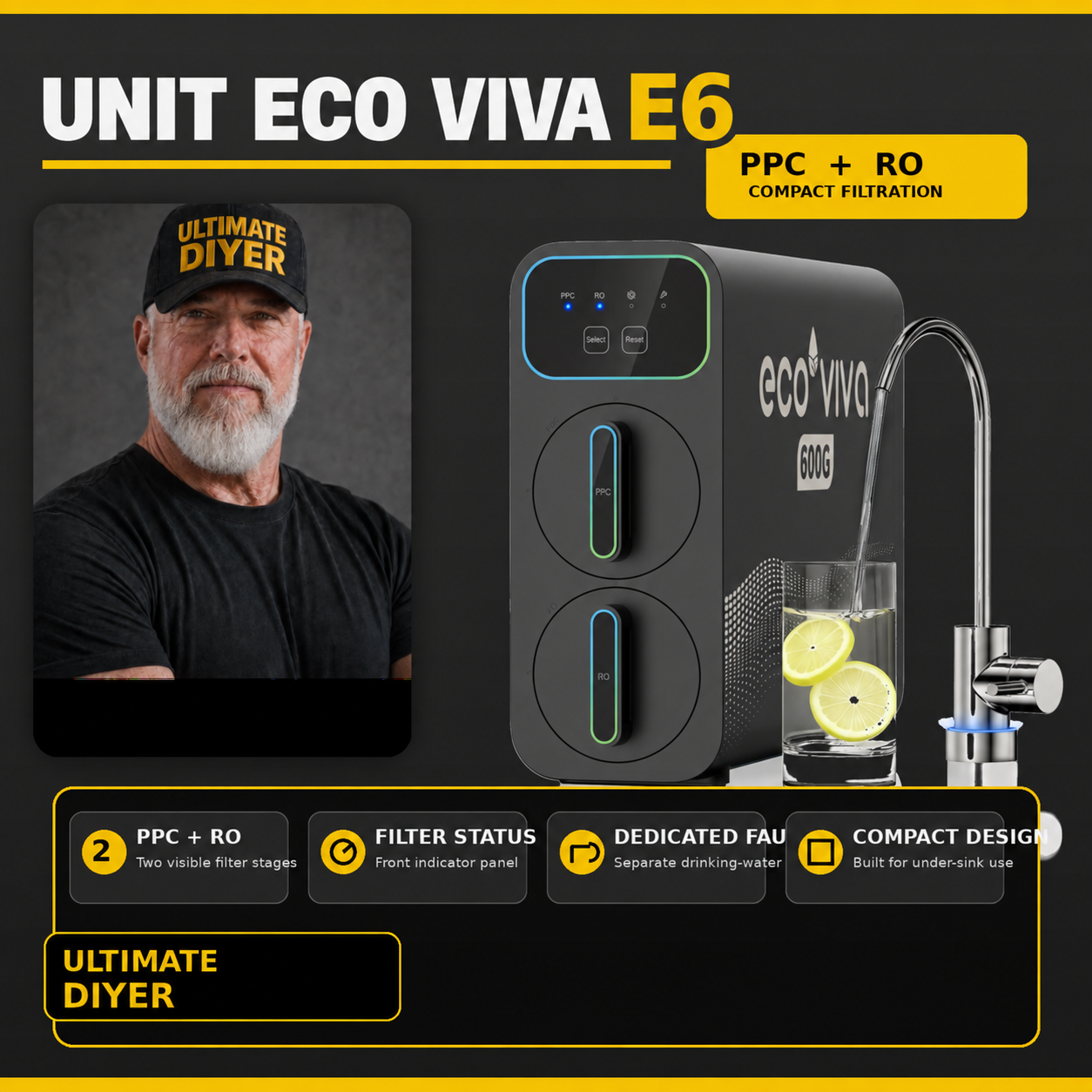
The Eco Viva E6 shows how much smaller modern under-sink RO systems can be. The current E6 is a compact tankless design, but it still requires a dedicated faucet opening, drain connection and power outlet. “Compact” should not be confused with “installation-free.”
The E6 will also receive its own installation and testing coverage so we can look at how much space it really saves, the plumbing requirements and real-world flow.
9. Countertop RO: The Category That Solves the Rental Problem
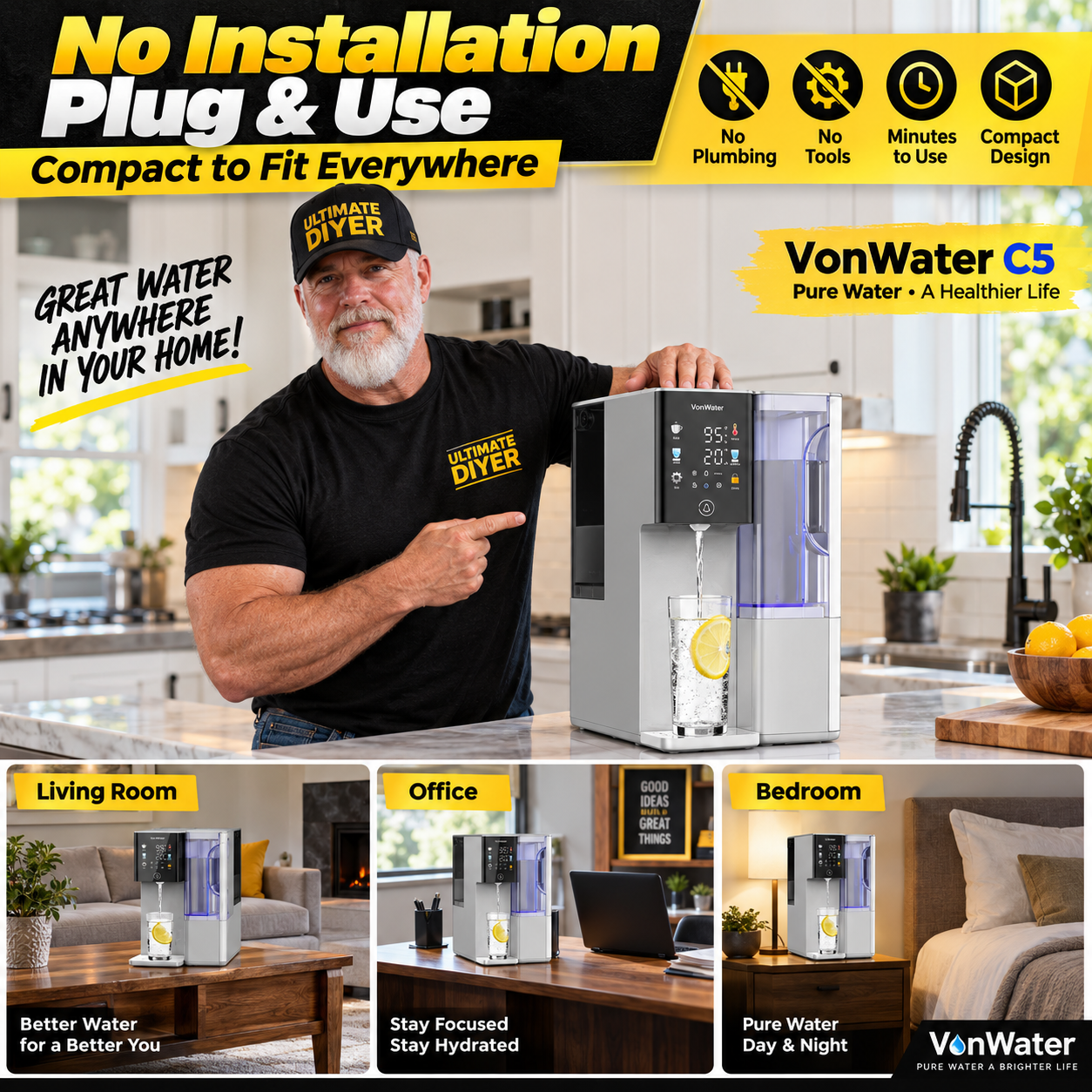
The attraction of countertop RO is not one particular brand – it is the category. There is no drain saddle, no permanent supply connection and no countertop drilling. The system treats water as an appliance instead of a plumbing fixture.
You fill a removable feed tank, the machine produces purified water, and you periodically empty the concentrate that the RO process leaves behind. That makes countertop RO especially appealing for apartments, rental homes, RVs, offices and homeowners who simply do not want another permanent installation.
What you give up: you become part of the process. You fill the feed tank, empty the concentrate tank, give up some counter space and use electricity.
There are many countertop RO machines on the market. In this project we used the VONWATER C5 for the deeper hands-on demonstration and also discussed the VONWATER S3. Those products are examples of the category – not the reason this article exists.
10. Why We Looked More Closely at the VONWATER C5 and S3
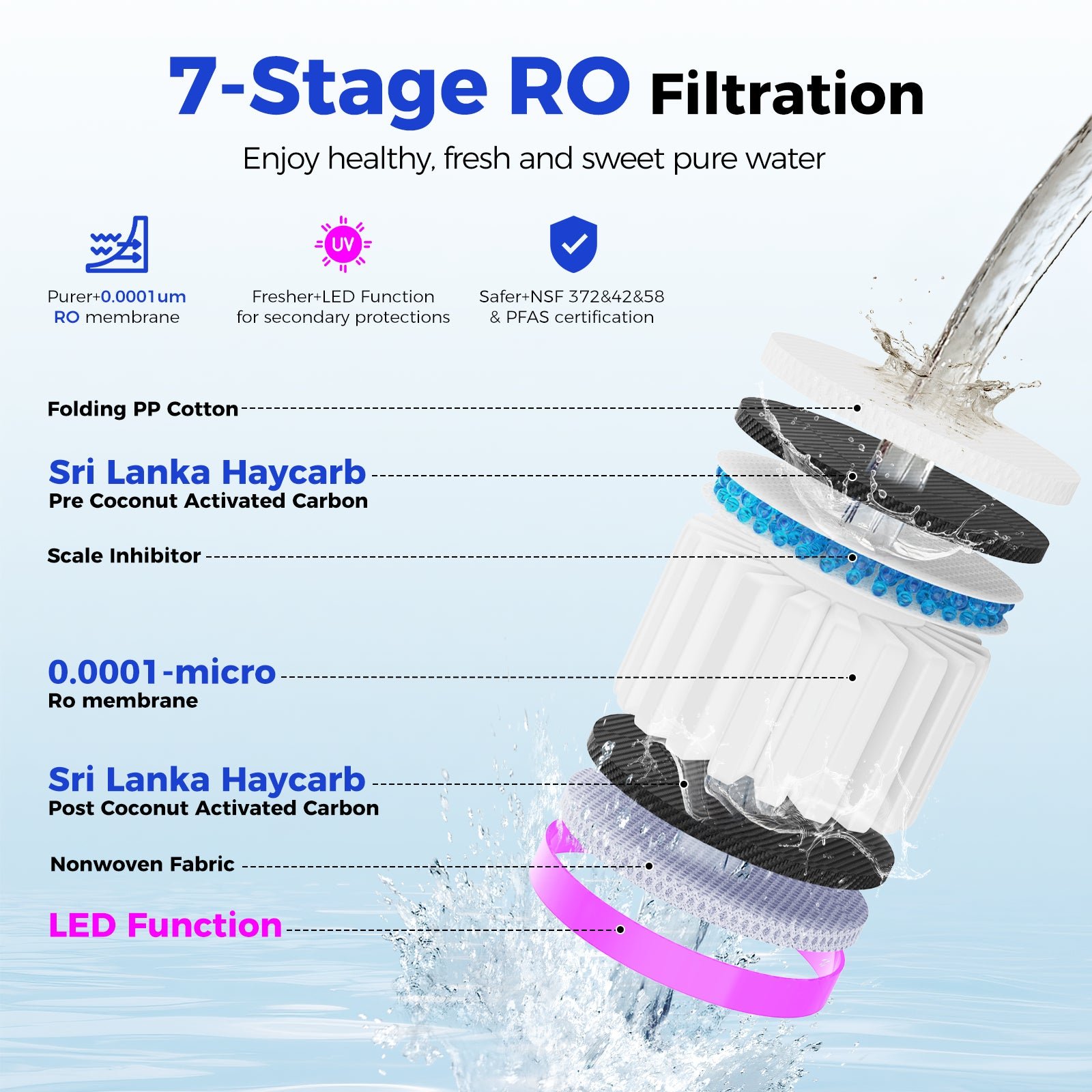
We spent more time on these two systems because they add features that are not typical of a basic under-sink RO system and are not universal across countertop RO machines.
The C5 packages its multi-stage treatment into a single replaceable all-in-one filter cartridge. That is simpler to maintain than a traditional rack of separate sediment, carbon, membrane and post-filter housings. Replacement cost still needs to be compared system by system, but fewer separate cartridges can reduce maintenance complexity and the number of parts you keep on hand.
Both VONWATER systems discussed in the video combine direct dispensing with a removable purified-water pitcher. That means you can fill one glass directly or move a larger amount of purified water to the refrigerator, stove or dining table.
11. Convenience Features That Go Beyond Filtration
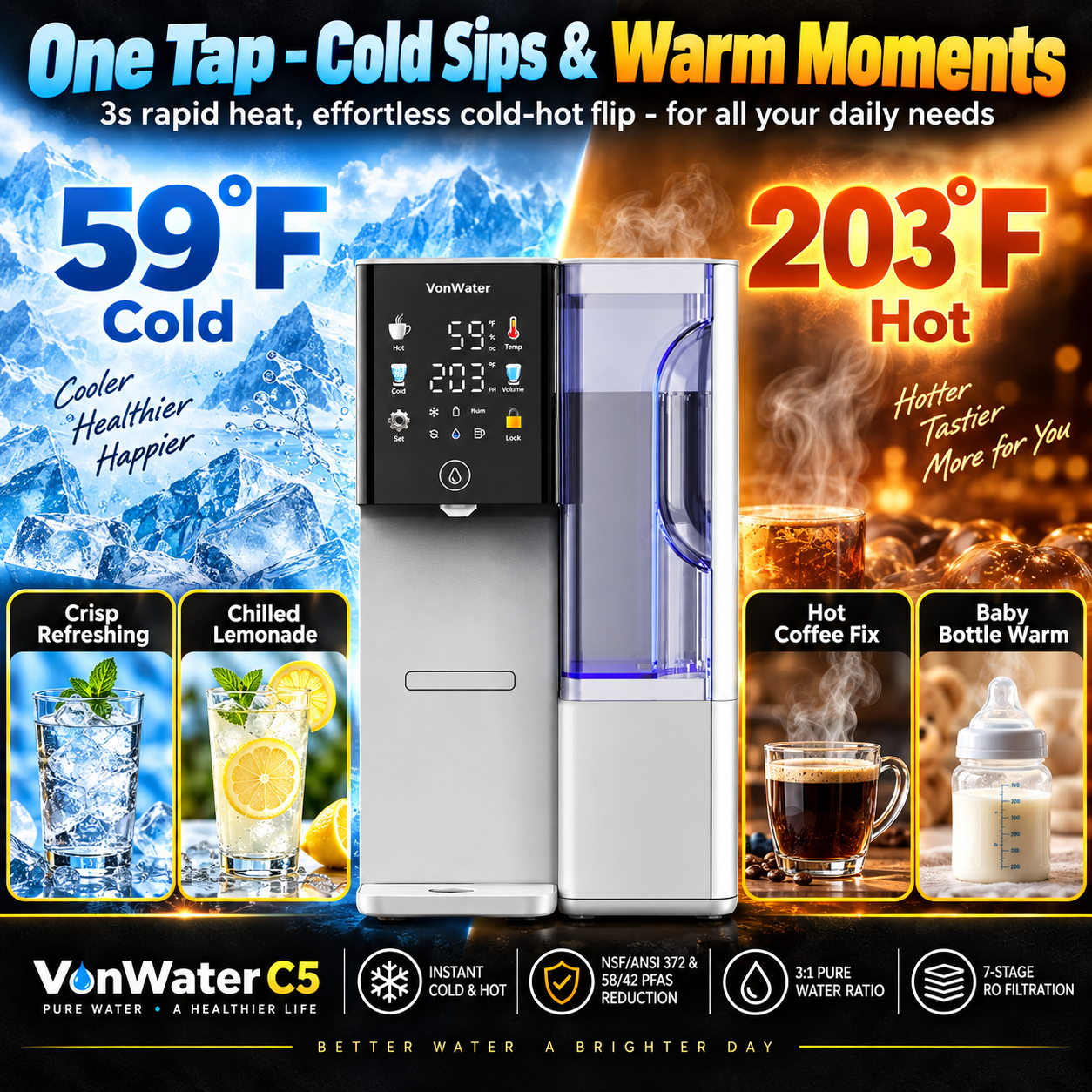
The C5 also adds functions unrelated to the RO membrane itself: chilled water, hot water, selectable dispense volumes and a lock control for hot-water use. Those conveniences can replace other countertop routines such as keeping a separate pitcher cold or waiting for a kettle.
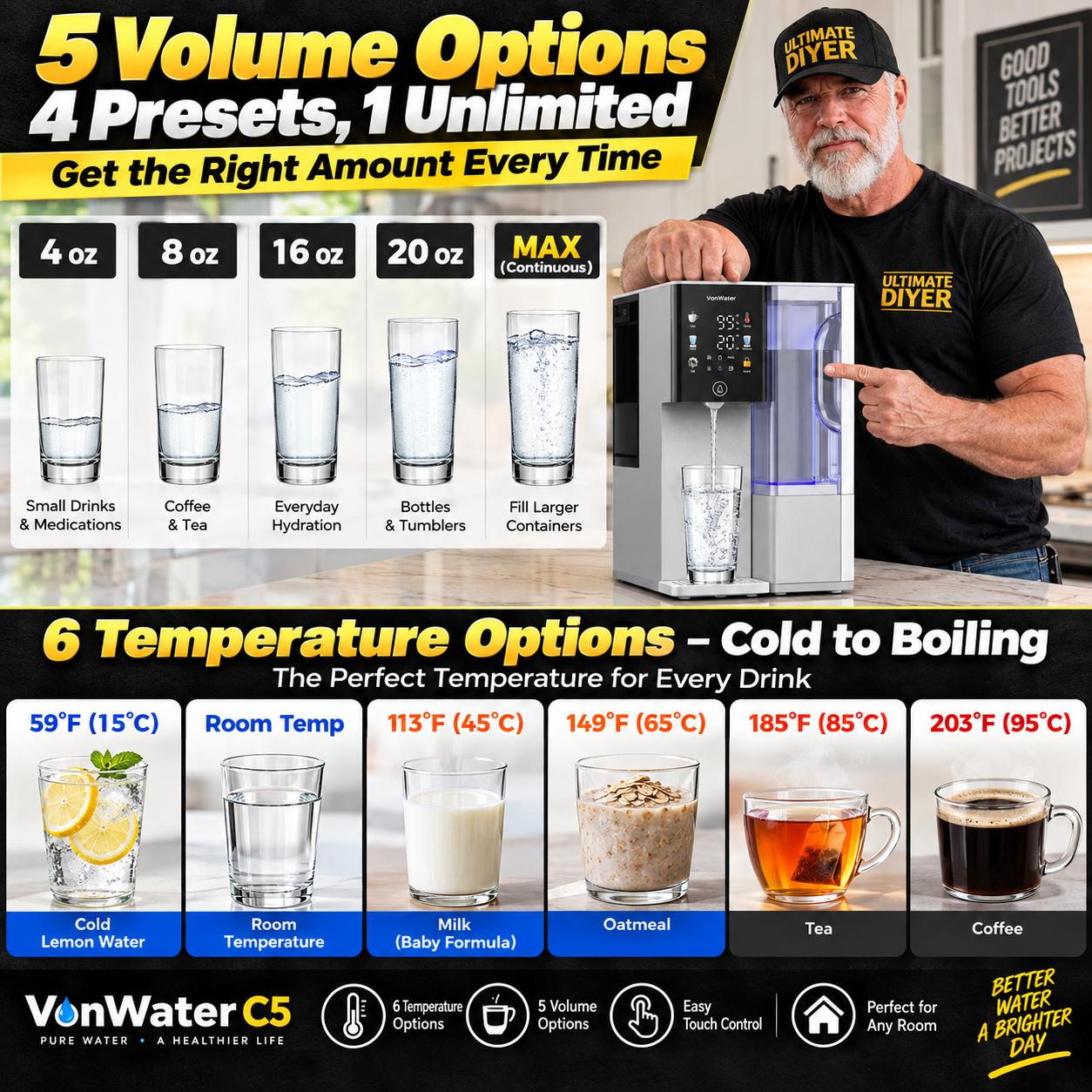
Those features are useful, but they do not mean every apartment needs a C5. Someone who only wants better-tasting water may be better served by an inexpensive pitcher. Someone who owns the home and wants a permanent system may prefer under-sink RO. The value is in matching the solution to the actual problem.
12. TDS Testing: Useful for Comparison, Not a Safety Verdict
For the companion video I used a Craft911 TDS meter to compare tap water, bottled water and countertop RO water. TDS means Total Dissolved Solids. A handheld meter is useful because it gives you a quick, repeatable comparison number that changes dramatically when RO removes a large share of dissolved ions.
But a TDS meter cannot tell you what those dissolved solids are. Calcium and magnesium contribute to TDS. So can sodium and many other dissolved substances. The meter reports conductivity; it does not identify the ingredients.
The Crazy Water Test
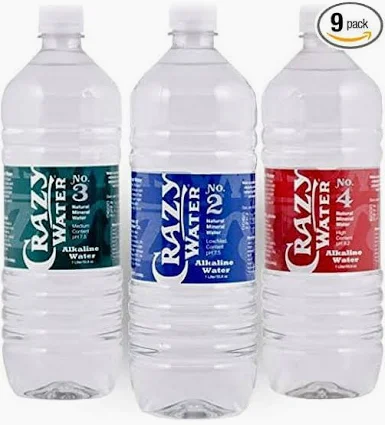
Crazy Water was the surprise sample used in the demonstration. Because it is mineral water, it intentionally contains a large amount of dissolved minerals. When the TDS reading jumped, that did not suddenly prove the water was “bad.” It demonstrated why a TDS meter should not be used as a stand-alone safety test.
The rule: low TDS does not automatically prove water is safe. High TDS does not automatically prove water is unsafe. If you need to know what is actually present, use an appropriate laboratory water test.
13. Cost Is More Than the Purchase Price
There are three different costs readers should keep separate: upfront equipment cost, ongoing consumables and convenience cost. Tap water has almost no equipment cost. Bottled water has almost no equipment cost but a large recurring cost. RO costs more upfront but can lower the per-gallon cost over time. Distillation adds electricity and time. Pitchers are inexpensive but need recurring cartridges.
Keep the math honest: municipal rates vary by city, bottled-water prices change constantly, and RO ownership cost depends on machine price, filter price, electricity, reject-water ratio, repairs and how long the appliance lasts.
A Simple Decision Guide
| Option | Cost Pattern | Installation | Best Way to Think About It |
|---|---|---|---|
| Tap water | Lowest cost | No equipment | Read local report; consider building plumbing |
| Filter pitcher | Low | No plumbing | Good when taste or odor is the main issue |
| Bottled water | Low upfront / high recurring | No install | Maximum convenience with recurring storage and plastic cost |
| Distillation | Moderate | No plumbing | Thorough treatment; slow and energy intensive |
| Under-sink RO | Moderate-high | Permanent install | Best when you own the space and want a fixed system |
| Countertop RO | Moderate-high | No plumbing | Strong renter/apartment compromise; fill and empty tanks |
14. What We Will Test Next
This article is intended to become the hub for our drinking-water treatment coverage. Future projects will go deeper into the topics that do not belong in one giant article:
- Aquasure traditional under-sink RO installation – plumbing connections, drain, faucet, filter changes and real-world use.
- Eco Viva E6 compact tankless RO installation – space savings, faucet and drain requirements, and measured flow.
- Countertop RO follow-up – longer-term filter maintenance, wastewater routine and actual cost per gallon after more use.
- TDS versus laboratory testing – what a handheld meter can tell you and what requires a real lab.
- Water softening versus drinking-water filtration – different problems, different equipment.
Bottom Line
The goal is not to convince every reader to buy a filter. Start with the local water report. Remember that building plumbing can still matter. Decide whether your actual problem is taste, convenience, a specific contaminant concern, permanent installation, or simply the inability to alter plumbing.
For some readers, the right answer will be tap water. For others it will be a pitcher. Some will choose distillation or a permanent under-sink RO. And for renters who want reverse osmosis without drilling or plumbing changes, countertop RO is a category worth understanding.
Teach first. Show the evidence. Use products as real examples. That is the approach most likely to help readers make a better decision.
Products Featured or Discussed
Sources
- City of Dallas Water Quality Report 2025
- CDC – About Home Water Treatment Systems
- CDC – Choosing Home Water Filters
- FDA – Bottled Water Regulation
- EPA – Secondary Drinking Water Standards / TDS
- Allafi – Effect of temperature and storage time on antimony migration from PET bottled water
- Carneado et al. – Migration of antimony from PET mineral-water bottles
- Water Research 2026 – PET bottled water, heat/handling and nano/microplastic release
- VONWATER C5 current product information
- Eco Viva E6 current product information
Affiliate disclosure: Some products shown or discussed may have been provided by manufacturers. Some links added to this guide may be affiliate links, which means Ultimate DIYer may earn a commission if you purchase through them at no additional cost to you. Product availability, specifications and pricing can change.