
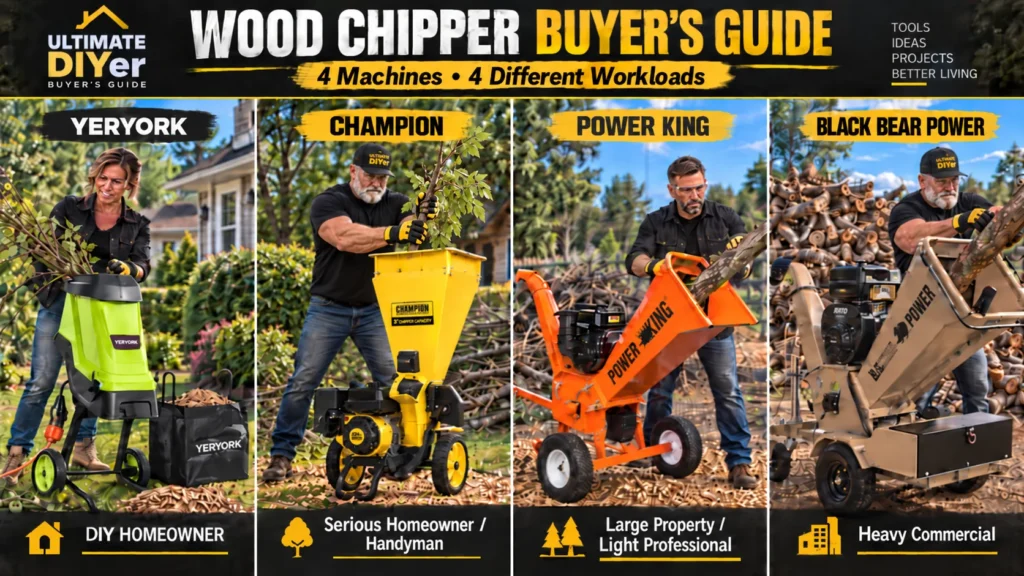
Wood chippers can look surprisingly similar when you are scrolling through product pages, but the machines behind those photos can be built for completely different jobs. A lightweight electric chipper used for pruning around a suburban home is not simply a smaller version of a 700-plus-pound commercial machine, and a commercial chipper is not automatically a better choice just because it can accept a larger limb.
The real question is: how much wood chipper do you actually need for the work you do? This Buyer’s Guide starts with the ownership questions that matter—power source, real cutting capacity, maintenance, blades, storage, towing, service, parts, and long-term use—before we get to four machines that represent four very different levels of work.
How we selected these wood chippers: I personally put the YERYORK 15-Amp electric wood chipper through a real-world Ultimate DIYer test. For the three classes we did not personally test, we researched competing models and selected machines that ranked near the top across the factors we considered most important for that workload: owner ratings, specifications, cutting capacity, engine or motor design, features, price, serviceability, parts availability, and overall suitability for the intended user.
That does not mean every selected machine wins every individual specification. In several categories we found competing machines that were stronger in one area. I will point those out and link to the closest alternatives so you can compare them instead of pretending there is only one reasonable choice. Manufacturer information and retailer owner feedback were reviewed in September 2026.
Quick Answer: What Size Wood Chipper Do You Need?
- Small electric chipper: best for pruning debris, small branches, occasional storm cleanup, compact storage, and homeowners who do not want another gasoline engine to maintain.
- 3-inch gas chipper: a strong step up for mature trees, larger residential lots, handyman work, and repeated cleanup where a small electric machine starts feeling slow or undersized.
- 5- to 6-inch gas chipper: starts making sense on acreage, farms, wooded property, rental-property maintenance, and light professional work where chipping becomes part of the job rather than an occasional chore.
- 7-inch commercial chipper: aimed at large-volume work, storm cleanup, landscaping/property-maintenance operations, and users who value throughput enough to accept the price, size, weight, maintenance, and storage requirements.
Start With Branch Size—but Do Not Stop There
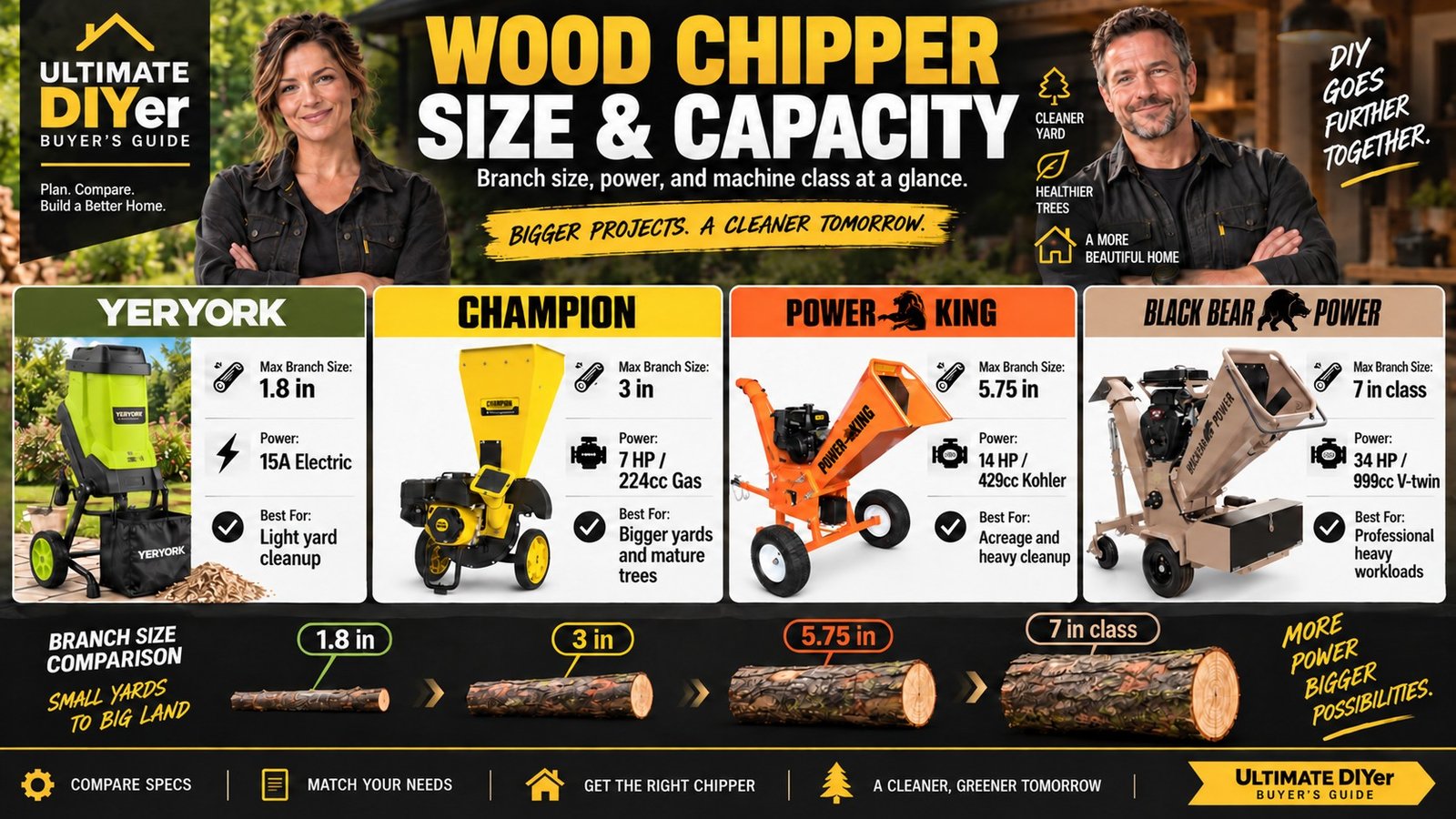
The diameter printed on the box is a maximum-capacity number, not a promise that every branch of that size will feed easily. Straight, green material can behave very differently from dry hardwood, crooked limbs, branches with forks, fibrous vines, or material with a lot of side growth. A chipper that is rated for a 3-inch limb may be happiest processing smaller material continuously, while the larger opening gives you headroom when an occasional bigger branch shows up.
That distinction matters because throughput can be more important than maximum diameter. If you have a huge pile of 1- to 2-inch limbs, a machine that self-feeds smoothly and clears chips quickly may save more time than a machine with a larger advertised opening that requires constant trimming, pushing, or clearing.
Electric vs. Gas: The Ownership Difference Is Huge
A corded electric chipper is the simplest ownership experience. There is no gasoline to store, no carburetor to gum up, no engine oil to change, no spark plug, and no starting battery. Plug it into a properly sized outdoor extension cord, keep the blades and feed area in good condition, and store the machine dry. The trade-off is lower cutting capacity and the limits imposed by a 120-volt electrical supply and extension-cord length.
The three larger machines in this guide use four-stroke gasoline engines. That means gasoline and engine oil are separate—you do not mix oil into the fuel like a two-stroke trimmer or chainsaw. Gas machines add engine oil changes, air-filter service, spark-plug inspection, fuel-system care, and, on electric-start models, battery maintenance. In return, they provide far more power and do not need to remain within extension-cord distance of an outlet.
If you only chip a few times per year, the simplicity of electric power has real value. If you are processing piles of larger limbs on acreage or at customer properties, the productivity advantage of gasoline quickly becomes more important than the extra maintenance.
Weight, Mobility, Towing, and Transport
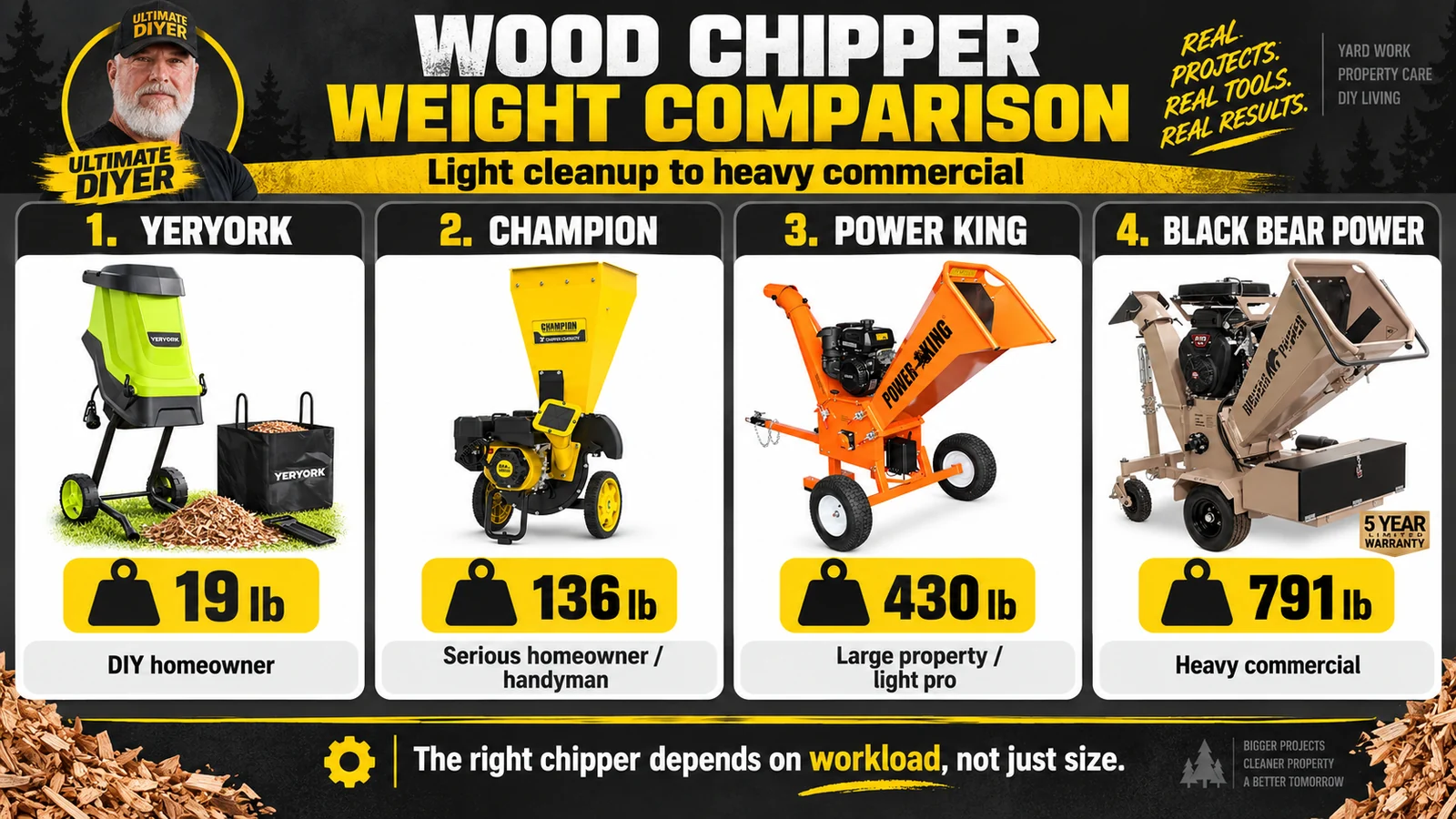
Weight changes how you use a chipper almost as much as branch capacity. A roughly 19-pound electric machine can be rolled out of a garage, used beside a tree, and put away by one person. A 100-plus-pound gas chipper is still movable around a residential property but takes more effort. Once you reach several hundred pounds, a tow bar, riding mower, lawn tractor, compact tractor, pickup, trailer, or other equipment becomes part of the ownership discussion.
Do not confuse “towable around the property” with “road towable.” A machine may have a hitch designed to move it behind a lawn tractor without being legal or safe for highway speeds. The Power King includes a tow bar for property transport, while the BIGBEAR BBC72 is sold with a dedicated 45-mph tow package. Always follow the specific manual and local towing rules rather than assuming any hitch makes a chipper road legal.
What the Different Chipper Classes Are Really Built to Do
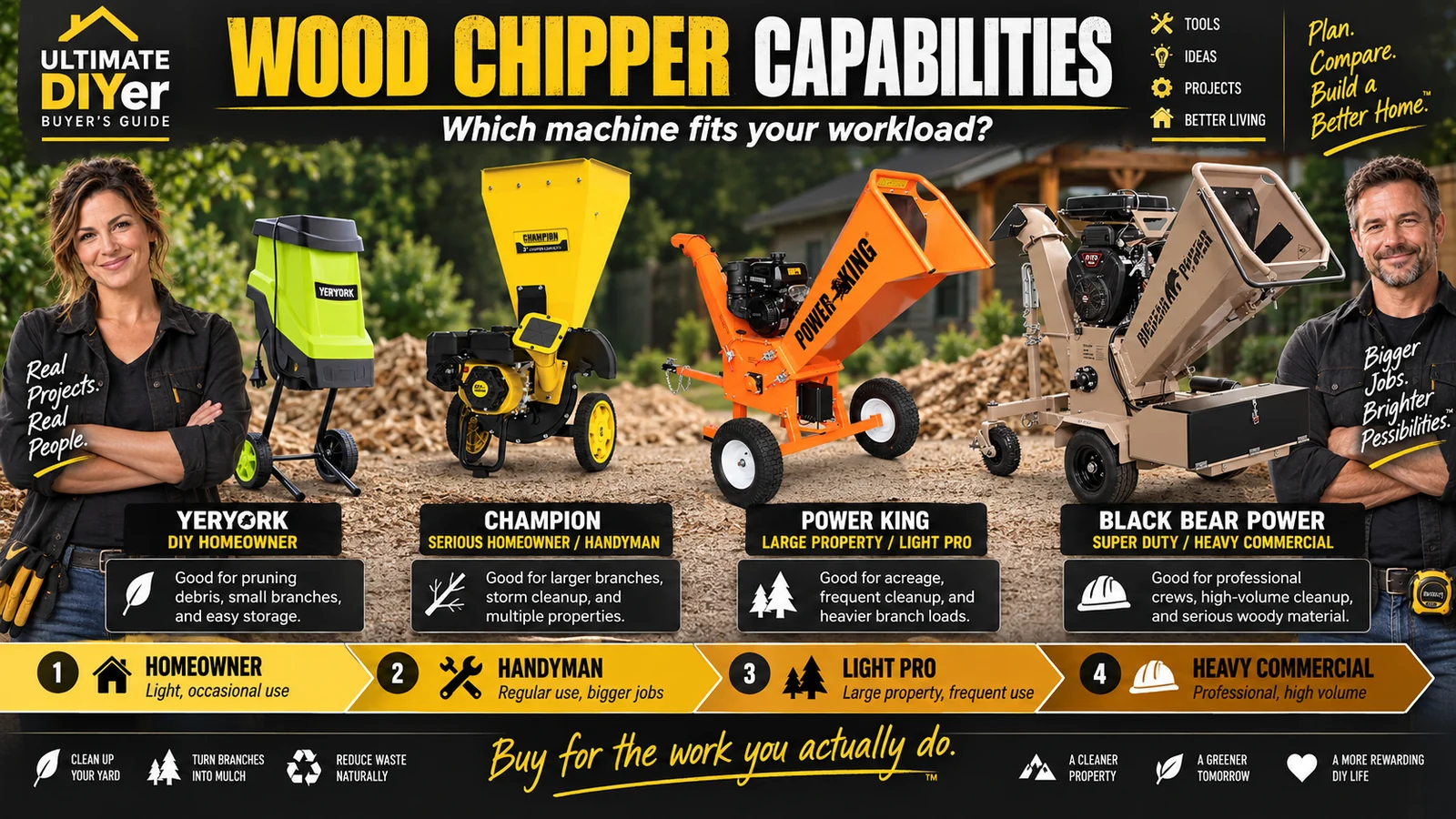
The smallest machines prioritize convenience. The middle class starts trading convenience for capacity. The large-property machines prioritize throughput, and the commercial class assumes the machine is there to make work move faster. This is why buying “one size bigger just in case” can become expensive very quickly.
A suburban homeowner might use a small electric chipper more often because it is easy to pull out and start. A handyman maintaining several properties may benefit from a 3-inch gas machine because it handles a broader range of cleanup without becoming trailer-sized equipment. A large-property owner can justify a 5-inch machine because a pile that would consume an entire weekend with a small chipper can become a much shorter job. A commercial operator may justify 7-inch capacity because labor time is more expensive than the machine.
Blades, Belts, Filters, and Other Consumables
Every chipper eventually turns sharp edges into wear items. Before buying, find out whether the blades are reversible, sharpenable, replaceable, proprietary, or a common pattern. Also look at belts, bearings, air filters, spark plugs, batteries, tires, grease points, and any special hardware required to reach the cutting system.
On the YERYORK, my parts research found that this small electric-chipper class uses a common replacement-blade style. I would treat the blades as replacement items rather than sharpening them. Replacement blades are inexpensive compared with the time and risk involved in changing the factory geometry on a small high-speed blade.
The Champion is different: its operator’s manual provides a sharpening specification for the chipper knives and also allows replacement when the knives reach their wear limit. On the larger Power King and BIGBEAR machines, blade access, belt condition, fastener torque, lubrication, and engine service become part of normal ownership. Bigger capacity usually means more service points, not fewer.
Maintenance and Long-Term Ownership
There is no honest universal answer to “How long will a wood chipper last?” A homeowner using a machine a few weekends per year puts a completely different number of hours on it than a property-maintenance company. What matters more is whether the machine is appropriate for the workload and whether you can continue to get blades, belts, filters, bearings, engine parts, and technical help several years from now.
- Electric: inspect the cord, plug, fasteners, wheels, feed chute and blades; keep cooling openings clear; store dry.
- Gasoline engine: add oil changes, air filter, spark plug, fuel care and seasonal storage. Electric-start models also add a battery.
- Large kinetic/drum chippers: add belt inspection, grease points, bearings, blade hardware and more involved access to the cutting assembly.
- Commercial use: keep maintenance records and inspect wear items more frequently because downtime can cost more than the replacement part.
Where Should You Store a Wood Chipper?
The YERYORK is easy to store indoors because it is light and compact, and that is where I would prefer to keep an electric machine: dry, protected from rain, with the cord and electrical components away from long-term moisture. The larger gas machines consume much more floor space. A garage, shed, barn, equipment building, or other covered storage is ideal. If a large unit must live outdoors, it should be protected from weather and stored according to the engine and manufacturer instructions.
Storage also includes fuel. A gasoline chipper parked for months with old fuel can create carburetor problems that an electric machine simply does not have. Before buying a large gas chipper, think about where the machine will physically live, whether you can maneuver it into that space, and how you will handle seasonal fuel and battery care.
Service: Dealer, Small-Engine Shop, or DIY?
A large part of our research was not just “How powerful is it?” but “What happens when something breaks?” Champion maintains manuals, exploded parts diagrams, parts support, and an authorized service network. Power King/QVTools provides direct support and the Kohler CH440 engine gives a small-engine shop a familiar commercial engine platform to work with. BIGBEAR/GX Commercial publishes parts catalogs and DIY service information for items such as blades and belts. The YERYORK has far fewer engine-related service needs because there is no gasoline engine at all.
That does not mean every local repair shop will accept every machine. Before spending several thousand dollars, it is reasonable to call a nearby small-engine or outdoor-power-equipment shop and ask whether they service the engine brand and whether they are willing to work on the chipper assembly itself.
Bigger Is Not Automatically Better
A 7-inch commercial chipper can process material a small electric machine cannot touch, but that does not make it the better homeowner tool. Bigger machines cost more, weigh more, require more storage, burn fuel, create more noise, have more maintenance points, and can require towing equipment just to move them conveniently. The right machine is the smallest class that can handle your real workload without constantly being pushed beyond what it was designed to do.
1. YERYORK 15-Amp Electric Wood Chipper
Best for the Typical DIY Homeowner
ULTIMATE DIYER — REAL-WORLD TESTED
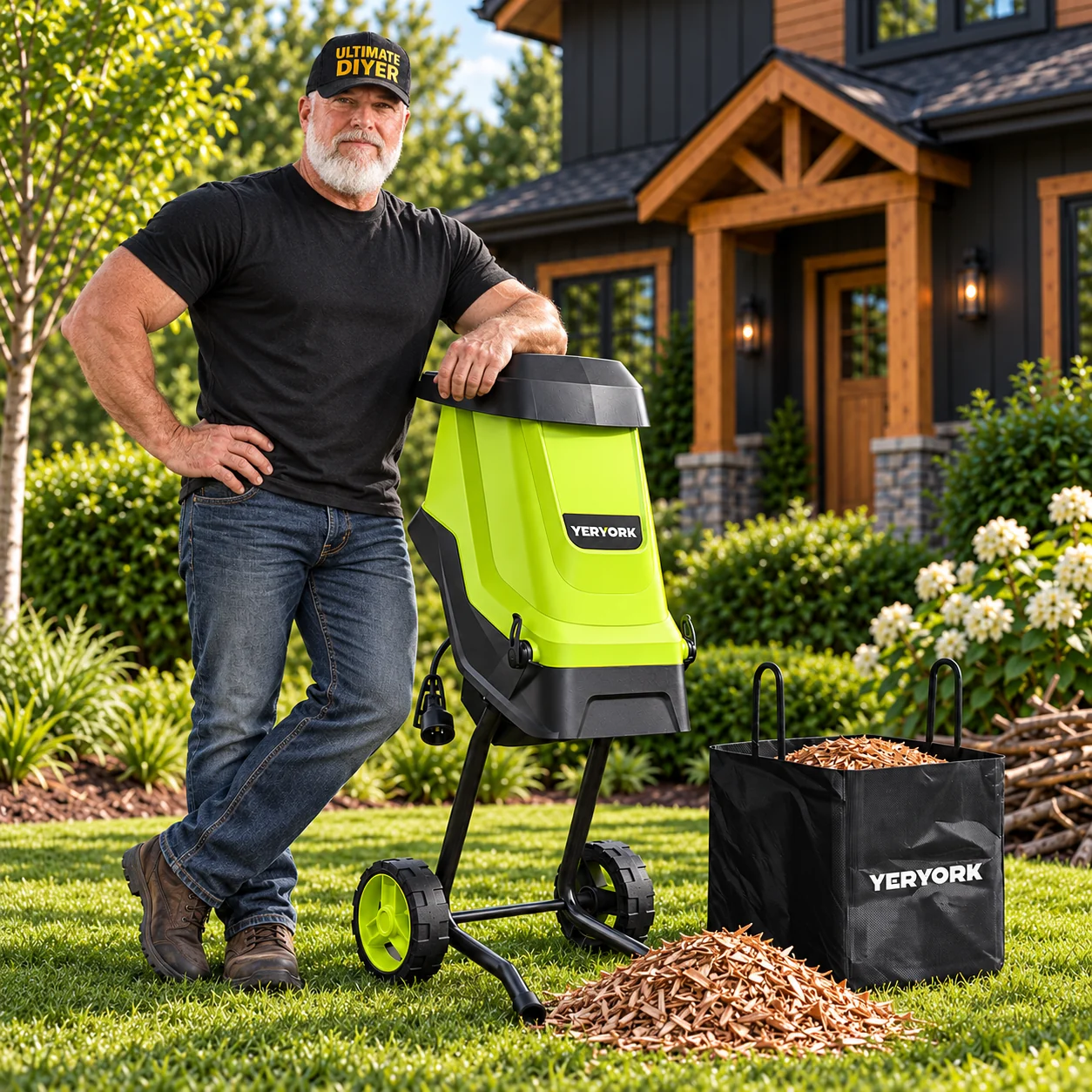
This is the one machine in the guide I personally used. The YERYORK runs a 15-amp corded motor at up to 4,000 RPM, uses dual-edge SK5 blades, carries a 1.8-inch rated branch capacity, and weighs about 19 pounds. That combination makes it much closer to a portable yard tool than to the gas-powered equipment farther down the page.
Why it earned the homeowner position: its biggest advantage is not raw power—it is how little ownership overhead it creates. There is no gasoline, engine oil, carburetor, spark plug, pull-start system, or battery to maintain. For normal pruning, small tree limbs, and occasional cleanup, that simplicity can matter more than owning capacity you rarely use.
Where it makes sense: suburban homes, smaller yards, routine pruning, small storm debris, and anyone who wants to turn manageable branches into mulch without maintaining another gas engine. It is also easy to store because one person can move it and it takes relatively little floor space.
Where it does not make sense: repeated 2- to 3-inch branches, acreage cleanup, large piles of hardwood, or paid property-maintenance work where time matters. A 1.8-inch rating should not be interpreted as permission to spend every weekend feeding maximum-diameter limbs through it continuously.
Blade and maintenance note: based on my parts research, I would replace the small universal-style blades rather than sharpen them. With an electric machine the routine is mostly keeping the feed path clear, inspecting the blades and fasteners, protecting the cord and plug, and storing it dry.
Key specs:
Power: 15A corded electric
Rated capacity: 1.8 in.
Motor speed: Up to 4,000 RPM
Reduction ratio: 21:1
Weight: About 19 lb.
Fuel/oil: None
Best storage: Indoor, dry garage or shed
▶ Watch My Real-World YERYORK Test on YouTube
Want to see the YERYORK actually in use? Click the video thumbnail below to watch my hands-on test on YouTube. It opens in a new tab so you can return to the guide afterward.

Closest Homeowner Alternative We Researched
Westinghouse W1.7WCAC 15-Amp Electric Chipper — This is a very close competitor: 15 amps, roughly the same 1.8-inch class, 4,000 RPM, SK5 blades, and a much larger public review history. Home Depot currently lists it in the low-4-star range with hundreds of reviews. If you prefer a model with a larger retailer review base, it deserves a look. I kept YERYORK as our main homeowner pick because it is the unit I actually tested.
2. Champion 200946 3-Inch Chipper Shredder
Best for a Handyman, Larger Yard, or Serious Homeowner
ULTIMATE DIYER — RESEARCHED SELECTION
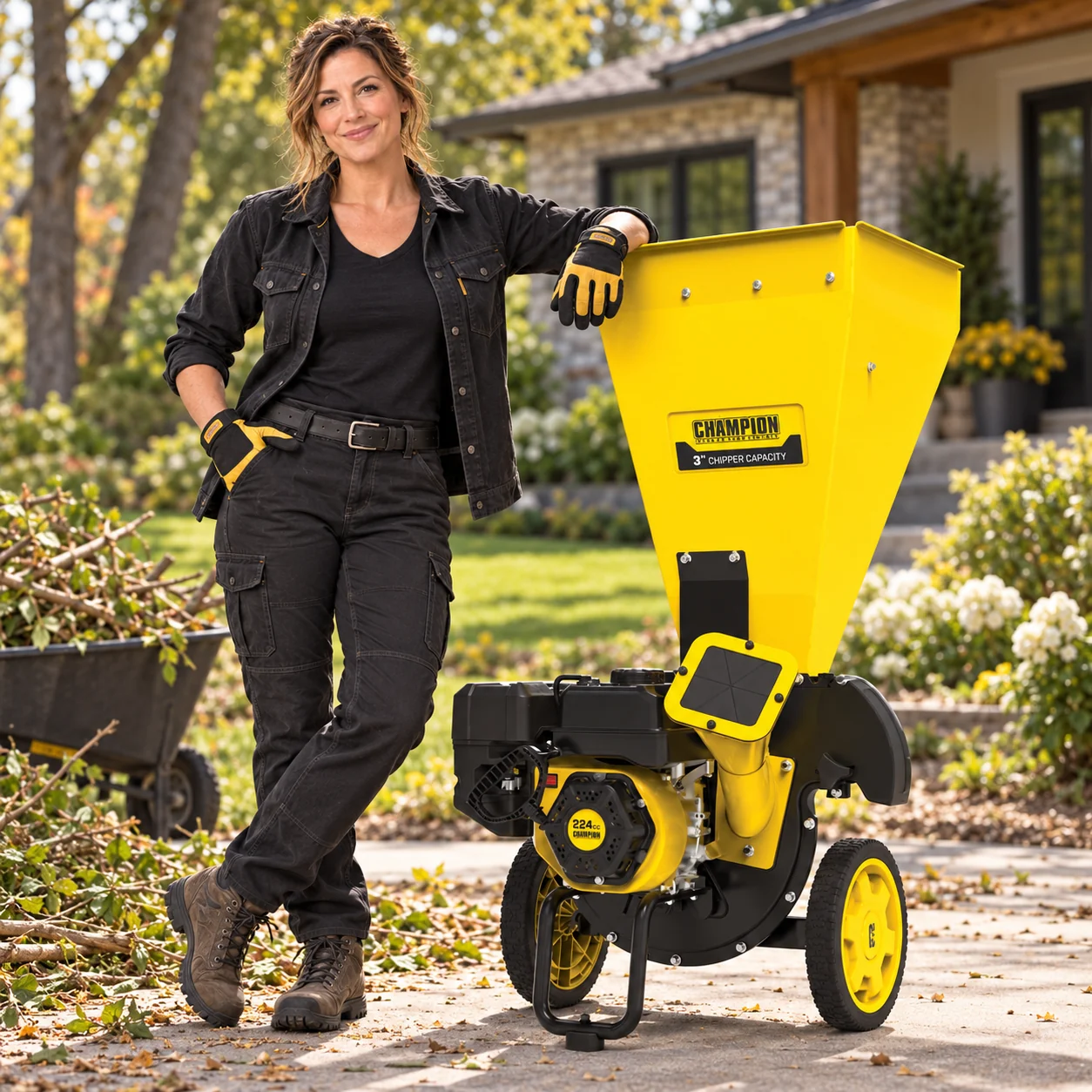
The Champion is where this guide makes the first major jump in ownership and capability. It uses a 224cc four-stroke gasoline engine and accepts branches up to 3 inches through the chipper chute, while a separate shredder hopper handles leaves and smaller yard debris. Compared with a 15-amp electric machine, this gives a handyman or serious homeowner much more room for mature-tree cleanup without jumping into several-hundred-pound commercial equipment.
Why it earned this position: the Champion combined usable 3-inch capacity with one of the strongest owner-review histories we found in the class. Home Depot currently shows roughly 4.2 out of 5 stars across more than 1,600 reviews, with about 90% recommending it. Champion also maintains operator manuals, exploded parts diagrams, replacement-parts support, and an authorized service network—important advantages once you move into gasoline equipment.
Maintenance: because it is a four-stroke gas engine, gasoline and oil are separate. Normal ownership includes engine-oil changes, air-filter and spark-plug service, fuel-system care, blade inspection, and checking hardware and moving components. Champion’s manual provides a sharpening specification for the chipper knives, so this is one machine where sharpening is an approved service procedure when done within the published limits.
Owner-feedback snapshot: the large review base is a major strength. Positive feedback repeatedly centers on value and wood-chipping ability. Some owners criticize the collection-bag attachment or say leaf shredding is less impressive than branch chipping. That is useful context if leaves are your main problem rather than woody debris.
Transport and storage: at roughly 136 pounds, this is still a machine you can move around a property on its wheels, but it is no longer something you casually lift onto a shelf. Plan on garage or shed floor space and normal small-engine seasonal storage. We did not identify it as a road-towable machine; transport between customer properties would normally mean a pickup or trailer.
Key specs:
Power: 224cc four-stroke gasoline engine
Rated branch capacity: 3 in.
Shredder hopper: Leaves, twigs, and woody material up to 1/2 in. (separate from the 3-in. chipper chute)
Weight: About 136 lb.
Fuel: Gasoline; engine oil separate
Service path: Champion parts/manuals, authorized service, or qualified small-engine repair
Closest 3-Inch Alternative We Researched
YARDMAX YW7565 3-Inch Chipper Shredder — The YARDMAX is a legitimate alternative with a 208cc Briggs & Stratton engine and the same 3-inch class of capacity. It has a solid owner-review base, but substantially fewer reviews than the Champion. We selected the Champion because its combination of review history, parts/service infrastructure, and overall ownership support gave it the stronger all-around case for this category.
3. Power King PK0915-EH1
Best for Acreage, Large Properties, and Light Professional Work
ULTIMATE DIYER — RESEARCHED SELECTION
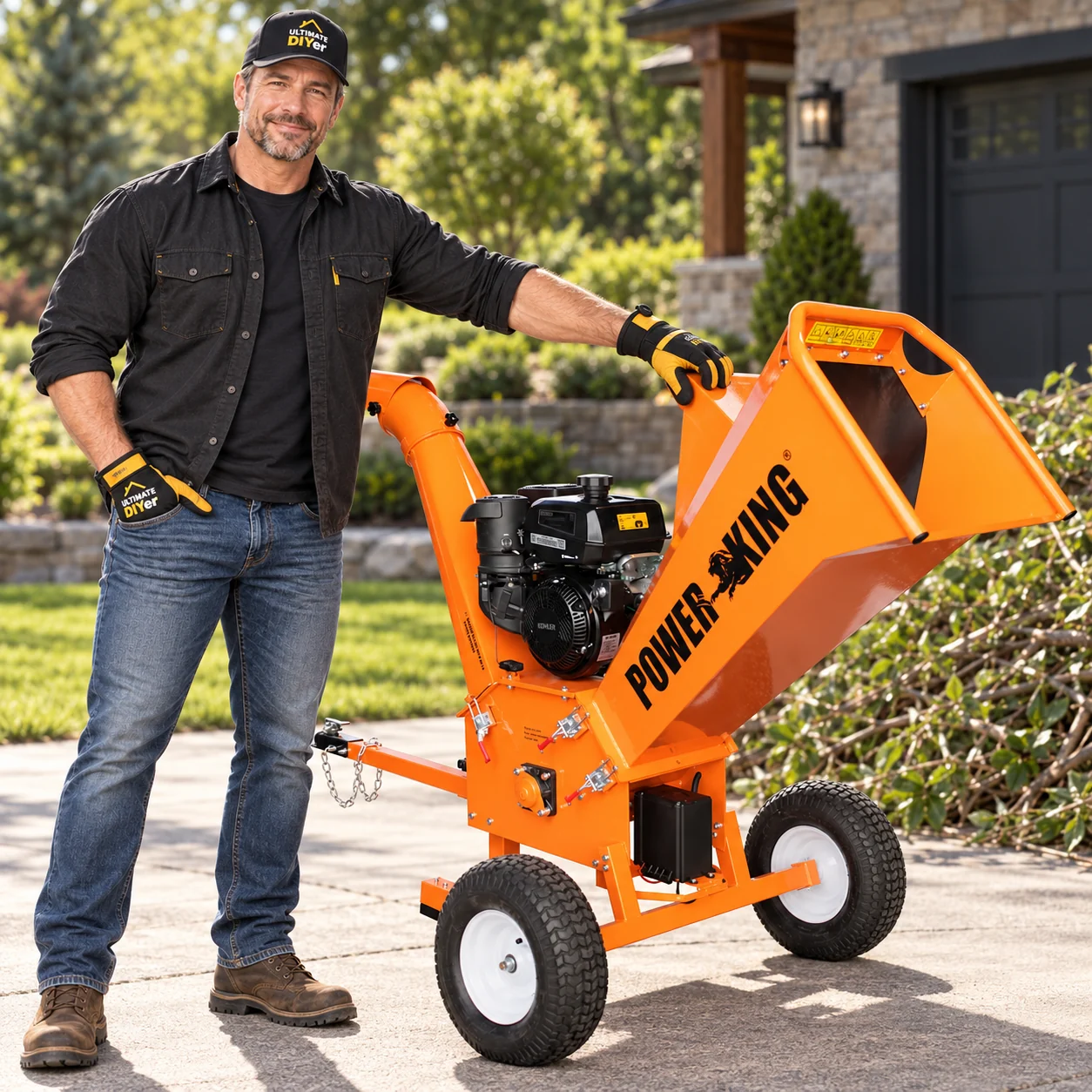
The Power King moves into a different ownership category. It uses a 14 HP, 429cc Kohler CH440 four-stroke engine, is rated for branches up to 5.75 inches, includes electric start, an hour meter, an extended wheelbase, extra blades, and a removable tow bar. At this level you are buying a machine because you regularly create enough woody debris to justify several hundred pounds of dedicated equipment.
Why it earned this position: it did not win every comparison. The DK2 OPC525-V2, for example, currently carries a higher average Home Depot rating, and BIGBEAR’s BBC52 offers a self-feeding commercial design. We still selected the Power King because its Kohler engine, large exact-model review history, 5.75-inch rated capacity, towability around property, parts support, and established design gave it the best overall balance for an acreage owner or light professional user.
Home Depot currently lists the PK0915-EH1 around 4.5 out of 5 stars with more than 360 reviews. That is a much larger exact-model owner sample than some newer competitors. Owner feedback includes strong praise for chipping performance, electric start, and the ability to reduce large piles of brush, while some negative reviews report clogging/jamming or assembly/setup frustrations. That mixed feedback is one reason we would not recommend buying strictly from the maximum-capacity number.
Maintenance: the Kohler CH440 is a conventional four-stroke gasoline engine, so expect oil, air-filter, spark-plug and fuel maintenance plus battery care for the electric start. The chipper itself adds blades, belts, grease points, tires, bearings, fasteners, and other wear items. This is still serviceable equipment, but the maintenance commitment is much closer to owning a piece of small machinery than owning a yard tool.
Towing and transport: the unit includes a tow bar and Home Depot/QVTools support identifies a 1-7/8-inch hitch ball on this model. That makes moving it around acreage much easier. I would treat this as property/equipment towing unless the manufacturer documentation for your exact configuration specifically approves road use; do not assume the hitch alone makes it highway legal.
Storage: Home Depot lists the machine at roughly 65 inches deep, 47 inches wide and 54 inches high. That is real equipment-floor-space territory. A garage, barn or equipment shed makes much more sense than trying to squeeze it beside ordinary lawn tools.
Key specs:
Engine: Kohler CH440 four-stroke
Displacement: 429cc
Power: 14 HP
Rated capacity: Up to 5.75 in.
Start: Electric
Tow bar: Yes
Fuel: Gasoline; engine oil separate
Service path: QVTools/Power King support plus small-engine service for the Kohler platform
Strong Alternatives We Researched
DK2 OPC525-V2 5-Inch Chipper — A very strong competitor with a 15 HP/420cc engine, reversible double-edge blades, roughly 309-pound weight, and a towable design that owners have reported using behind riding mowers. Its Home Depot rating is excellent, but the review sample is much smaller than the Power King’s. If you value lower weight and a strong early owner score, it is worth comparing directly.
BIGBEAR POWER BBC52 5-Inch Tornadic — This is another serious alternative with a 15 HP gas engine, self-feeding design, electric start, tow package, and large feed chute. One caution when comparing ratings: Home Depot appears to share or pool some Tornadic-family reviews across multiple variants, so we do not treat the displayed review count as a clean exact-model sample.
4. BIGBEAR POWER Tornadic BBC72
Best for Heavy Commercial and High-Volume Property Work
ULTIMATE DIYER — RESEARCHED SELECTION
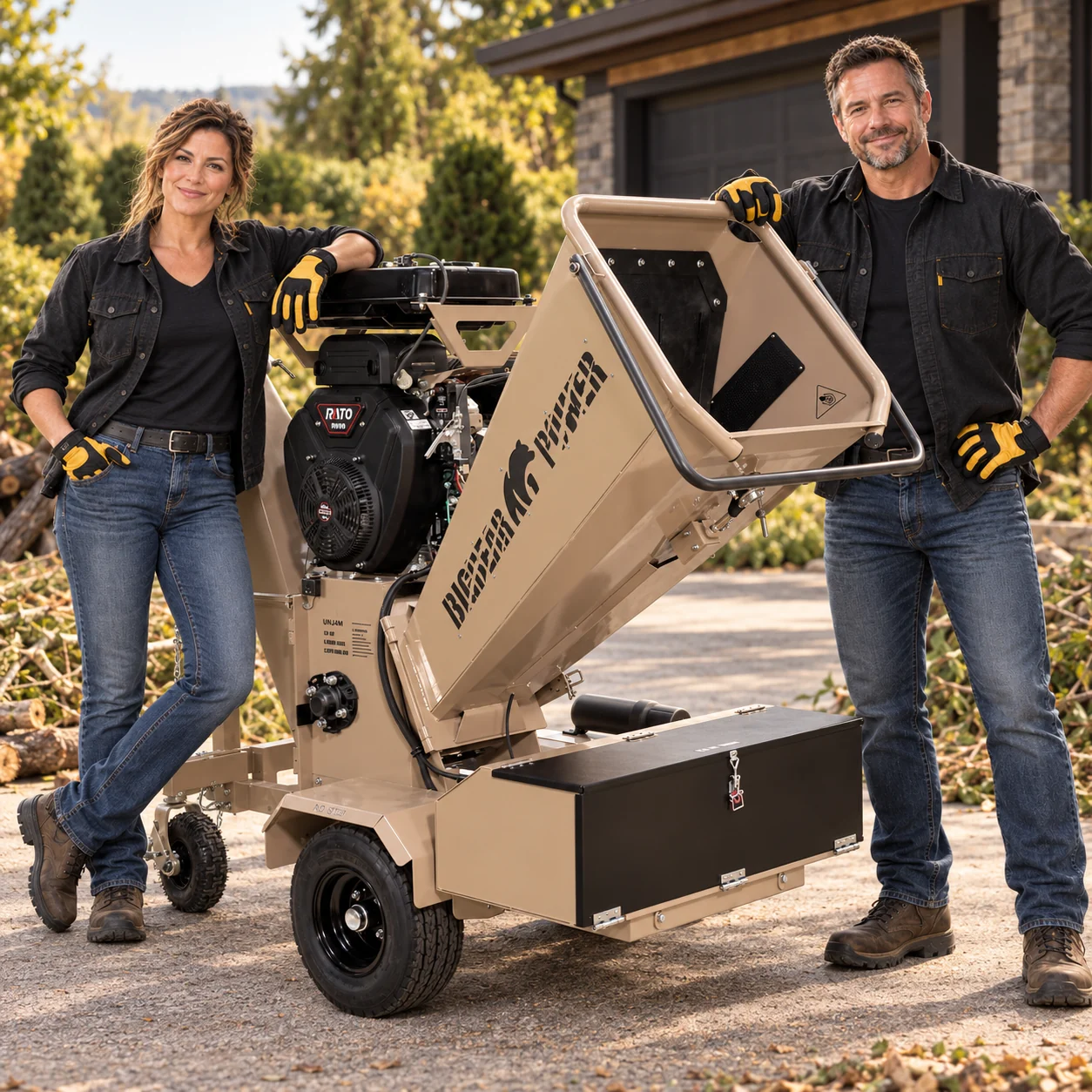
The BBC72 is where this guide leaves normal homeowner equipment behind. It is a 7-inch-class commercial chipper powered by a 34 HP V-twin gasoline engine, with self-feeding capability, electric start, a large feed system, and a dedicated 45-mph tow package. The machine is built around productivity: bring the chipper to the pile, feed larger material continuously, and move chips where you need them.
Why it earned the commercial position: the specification jump is substantial, but the ownership infrastructure also mattered. BIGBEAR/GX Commercial publishes a parts catalog for the BBC72 with machine-specific blades, belts, filters, plugs, battery, carburetor, tires, bearings and other service items. The company also publishes DIY service procedures for items such as blade and belt work. When a machine costs several thousand dollars, being able to identify replacement parts matters nearly as much as the horsepower number.
Owner-rating caution: Home Depot currently shows a very strong rating in the Tornadic family, but the retailer’s review feed appears to include reviews shared across multiple BIGBEAR variants. We therefore treat that score as useful family-level feedback rather than claiming every displayed review belongs specifically to the BBC72.
Maintenance: this is commercial-style gasoline equipment. Plan on engine oil, filters, spark plugs, fuel care, battery service, belts, bearings, grease points, blade inspection, fastener checks, tires and towing hardware. The blades and parts are machine-specific rather than the common small-electric style used on the YERYORK. This is equipment that rewards preventive maintenance.
Towing and storage: unlike a simple property tow bar, the BBC72 is sold with a 45-mph tow package. That still does not replace checking the manufacturer instructions and local laws before road travel. Storage is also a serious consideration: this is a large, heavy machine that belongs in a barn, equipment building, commercial shop or other protected area where you can maneuver it safely.
Who should actually buy it: landscaping/property-maintenance operations, farms, large wooded acreage, frequent storm cleanup, and users who regularly produce enough large material that smaller machines would become a labor bottleneck. A suburban homeowner with occasional trimming would be buying a tremendous amount of machine to solve a very small problem.
Key specs:
Power: 34 HP V-twin four-stroke gasoline engine
Rated capacity: 7 in.
Feed: Self-feeding
Start: Electric
Tow package: 45-mph package supplied with machine
Fuel: Gasoline; engine oil separate
Service path: GX Commercial/BIGBEAR parts support plus qualified engine/equipment service
Which One Would I Buy?
If I had a normal suburban home and was mostly pruning small limbs, I would stay electric because the convenience would probably make me use the machine more often. That is exactly why the YERYORK makes sense in the first category. If I were maintaining several homes, doing handyman work, or regularly cleaning up mature trees, I would move into the Champion’s 3-inch gas class.
On acreage, the question changes from “Can it chip this branch?” to “How long will it take me to process this entire pile?” That is where the Power King class starts making economic sense. And once you are running a landscaping/property-maintenance operation or processing large woody material regularly, the BBC72 class becomes about labor savings and throughput rather than homeowner convenience.
Quick Wood Chipper Size Comparison
If you are trying to decide what size wood chipper makes sense, this table gives you the short version of the four equipment classes covered in this guide.
| Use Level | Example Machine | Rated Branch Capacity | Best Fit |
|---|---|---|---|
| DIY Homeowner | YERYORK 15-Amp Electric | 1.8 in. | Routine pruning, small limbs, compact suburban yards |
| Handyman / Heavy Residential | Champion 200946 | 3 in. | Larger residential cleanup, mature-tree pruning, repeated property work |
| Acreage / Light Pro | Power King PK0915-EH1 | 5.75 in. | Acreage, frequent debris piles, property maintenance and light professional use |
| Heavy Commercial | BIGBEAR POWER Tornadic BBC72 | 7 in. | High-volume woody debris, landscaping crews and commercial throughput |
Important: rated branch capacity is a maximum specification, not a promise that every crooked, wet, forked or dense hardwood branch at that diameter will feed the same way. Species, moisture, branch shape, blade condition and feed design all affect real-world performance.
Wood Chipper FAQ
What size wood chipper do I need for home use?
For routine suburban pruning and small branches, an electric chipper in roughly the 1.5- to 2-inch class is usually the easiest place to start. If you regularly deal with larger mature-tree limbs or repeated cleanup across multiple properties, moving into a 3-inch gas chipper can make more sense.
Is a 3-inch wood chipper enough for most homeowners?
For many homeowners, yes. A 3-inch-class machine covers substantially larger debris than a small electric chipper without moving into several-hundred-pound commercial equipment. The right choice still depends on how often you use it and the type of branches you actually need to process.
Should I buy an electric or gas wood chipper?
Electric chippers are lighter, quieter and easier to store, making them a good fit for occasional pruning near the house. Gas machines make more sense when branch size, debris volume or distance from electrical power starts becoming the limiting factor.
Can a wood chipper handle green or wet branches?
Many wood chippers can process green material, but wet leaves, stringy growth, forks and flexible branches can feed differently than straight dry wood and may increase the chance of plugging. Follow the machine manual for allowed material and feed limits, and do not assume the maximum diameter applies equally to every type of branch.
Can wood chipper blades be sharpened?
It depends on the machine. In this guide, I treat the YERYORK’s small replaceable blades as replacement items, while Champion publishes a sharpening specification for the chipper knives in its operator documentation. Larger machines use model-specific blades and service procedures, so always follow the manufacturer guidance rather than assuming every chipper knife should be sharpened the same way.
More DIY Guides and Buying Guides
Still researching your next project or tool purchase? Browse our Ultimate DIYer Buying Guides for research-based product comparisons, our DIY Guides for step-by-step project help, and Budget Tools for hands-on coverage of lower-cost tools and equipment.
Final Thoughts
The best wood chipper is not automatically the machine with the largest opening or the biggest engine. It is the machine that matches your branch size, volume of debris, available storage, ability to move the equipment, willingness to maintain it, and access to parts and service.
For a normal homeowner, electric simplicity can be a major advantage. For a handyman or serious homeowner, a 3-inch gas machine opens up much more work. For acreage and light professional use, 5-inch-class equipment starts saving serious time. And for heavy commercial work, a dedicated 7-inch machine can turn labor into production—but only if you actually have enough work to justify owning it.
The goal is not to buy the biggest chipper. It is to buy enough chipper for the work you actually do—and to know what owning that machine will require after the purchase.
Affiliate disclosure: Some links in this Buyer’s Guide are affiliate links. If you purchase through one of these links, Ultimate DIYer may earn a commission at no additional cost to you. Affiliate relationships do not determine our opinions, research findings, or recommendations. Product ratings and review counts can change over time.